
How I Write (According to 1,200 Messages)

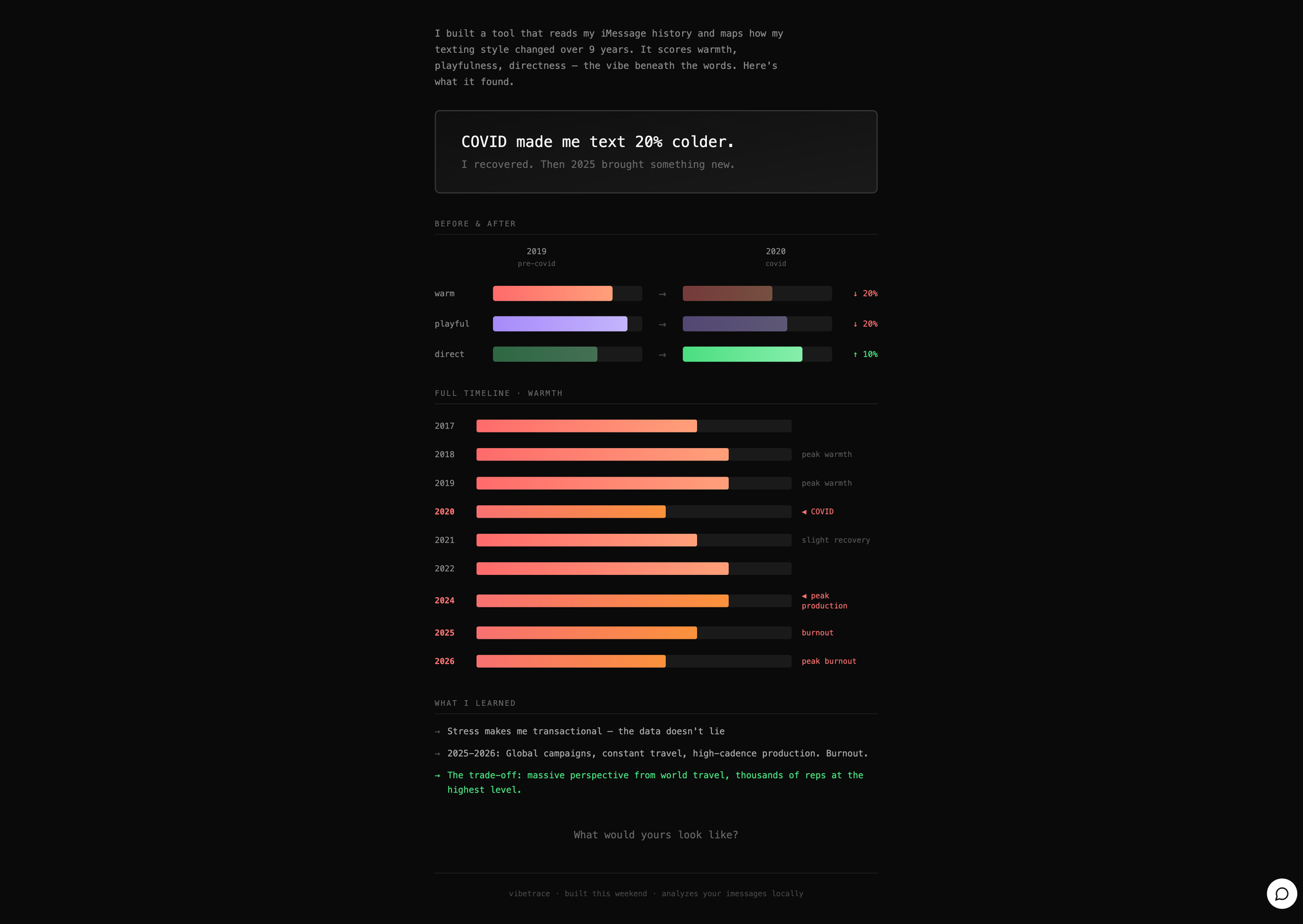
For months I'd been writing voice guides by hand. "Short sentences. Lowercase. Casual but direct. Fragments are fine." I'd paste them into prompts and hope for the best.
The output always felt close but off. Like a cover band that knows all the words but sucks at timing.
So over the weekend I built something different. VibeTrace reads my actual iMessage history and figures out how I write. Not how I think I write. How I actually write.
It runs locally on my MacBook, stripping names, phone numbers, emails before anything gets analyzed by AI. Samples around 1200 message chunks and builds a voice profile from real patterns.
The difference between describing your voice and analyzing it is the difference between a sketch and a photograph. One is from memory. The other is from data.
Turns out I do things I never would have listed in a style guide. Patterns I couldn't see because I was too close. The way I start sentences. Where I drop words. How often I actually use fragments versus how often I think I do.
A manual voice guide is a guess. A good guess, maybe. But still a guess.
This little project fits into something bigger I've been working on. I got tired of re-teaching AI the same things about me across every project. My voice. My preferences. My decision-making patterns. VibeTrace is only one piece of that puzzle. Instead of telling AI who I am, I'm letting it learn from what I've actually done.
Now when I say "make it sound like me," it actually can. Not because I wrote better instructions. Because I gave it better source material.
The best creative direction I've ever given wasn't a brief made from thin air. It was a folder of references I love.
Same principle applies here. Show, don't tell. Even when the audience is a language model.