
Entropy Doesn't Stay Where You Put It
Steve Jobs Wasn't a Perfectionist. He Was a Physicist.

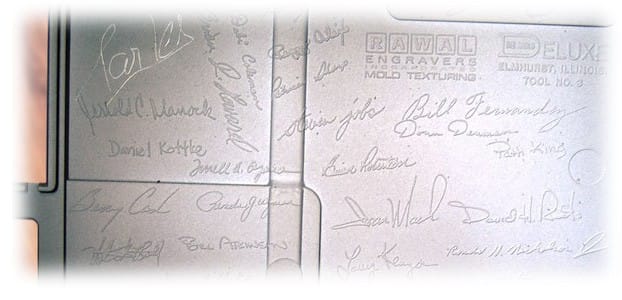
Jobs had the team sign the inside of the Mac.
All 47 of them. Every engineer, every designer. Their names, molded into the plastic, hidden behind a panel you need tools to open. No customer would ever find them. Apple made sure of that.
A yearbook for a machine no one was supposed to open.
He put them there for one reason: so the people who built it would know they'd signed it. When you sign something, you're not just finishing it. You're claiming it. You're saying: I stand behind this even if no one ever knows I touched it.
Not branding. Not performance. A private ritual. A vow.
His father taught him the underlying principle. "A great carpenter doesn't use cheap wood for the back of a cabinet," he told young Steve. Quality in the unseen places too. Even where no one looks.
Jobs ran that into every room he occupied. He made engineers redo circuit board layouts because the lines weren't straight enough. He took a calligraphy class at Reed College a decade before building the Mac — and those letterforms found their way into every screen Apple ever shipped. He made factory workers wear white gloves to assemble the finished machines.
Everyone called it perfectionism. Or obsession. Or being difficult.
I think they were misreading it.
There's a book called The Quantum Rules, physicist Kunal Das applying the laws of thermodynamics to how we actually live. The one that won't leave me: entropy always increases. Disorder is the default. Order requires constant energy to maintain.
Your desk gets messy. Your codebase accumulates debt. Your team loses sharpness. Not because something went wrong. Because that's the baseline. The universe tilts toward disorder, and you have to actively fight it or you get it.
Das calls it "nature's tax on everything."
Jobs paid the tax in the visible places. He also paid it in the invisible ones. And I think he understood something most people don't:
Entropy doesn't stay where you put it.
Cut a corner in the unseen place, the internal layout, the error state nobody triggers, the back of the fence, and that decision becomes the template. Not officially, not on purpose, but it teaches everyone around you what standards you actually hold. It teaches you what you're capable of tolerating.
Those tolerances compound.
One "good enough" trains the next one. Normalized sloppiness isn't a single call. It's a setting you adjust, quietly, over time.
None of this means never ship. Jobs also said "real artists ship." He'd make you sign the inside of the Mac and then scream about the deadline. That's not a contradiction. He was optimizing for: ship excellent work. Not "ship eventually." Not "ship once it's perfect."
Ship something you'd put your name on.
The distinction is between strategic tradeoffs and normalized sloppiness.
Strategic tradeoff: "We're not building this feature yet. Here's exactly why." Named. Intentional. You know what you left behind.
Normalized sloppiness: "It's fine, nobody will notice." That's entropy winning and it doesn't stay contained.
I've spent 15 years directing campaigns. Spend enough time on set and you develop an eye for the gap between "we got the shot" and "we got the shot."
Most of the time no one in the audience knows the difference. The cut works. The image lands.
But you know.
That awareness the distance between what you made and what you could have made is always there. It either shrinks or widens, and it widens when you stop fighting it.
Notice what the signing ritual does: it flips the whole external validation loop. The audience doesn't see your name. The market doesn't reward you for it. The company doesn't promote you because of it. It's just you and the thing you made, locked in a room. Your permanent record as a human, not as an employee.
That's a different level of authorship than "I worked on this project."
Jobs wasn't being difficult when he forced the team to redo things that "worked fine." He was building that kind of authorship into the culture. He was refusing to let entropy win in that specific spot, because he knew it wouldn't stay in that spot.
The cost of doing things right is real. Time. Energy. Money. Sometimes a room full of people who think you're being unreasonable.
The cost of not doing things right is also real. You just pay it later, compounded, in ways that are harder to trace back to the original shortcut.
The 47 signatures inside the Mac. Nobody ever sees them.
The team knew.
That's the whole thing.